Council to give feedback on new wastewater discharge standards
Like drinking water, how we handle wastewater is getting a major overhaul in New Zealand, with local authorities providing feedback on proposed national environmental performance standards, and how they will impact on their communities.
At the meeting held at Ranfurly recently (Wednesday 26 March 2025), the Central Otago District Council (CODC) discussed the key points concerning new standards for wastewater discharge that would go into its feedback to the water regulator Taumata Arowai.
The regulator has released a discussion document on the proposed wastewater environment performance standards, inviting feedback from councils, which closes 24 April 2025. The standards would drastically change the consent requirements for urban wastewater discharges, CODC Group Manager – Three Waters Julie Muir said.
Her report to Council listed performance level at the district’s wastewater treatment plants, consent expiry date, current normal population, the existing discharge environment, and the potential classification under the new standards. A high-level assessment of Central Otago’s wastewater schemes is available in the full report: Agenda of Council meeting - Wednesday, 26 March 2025).
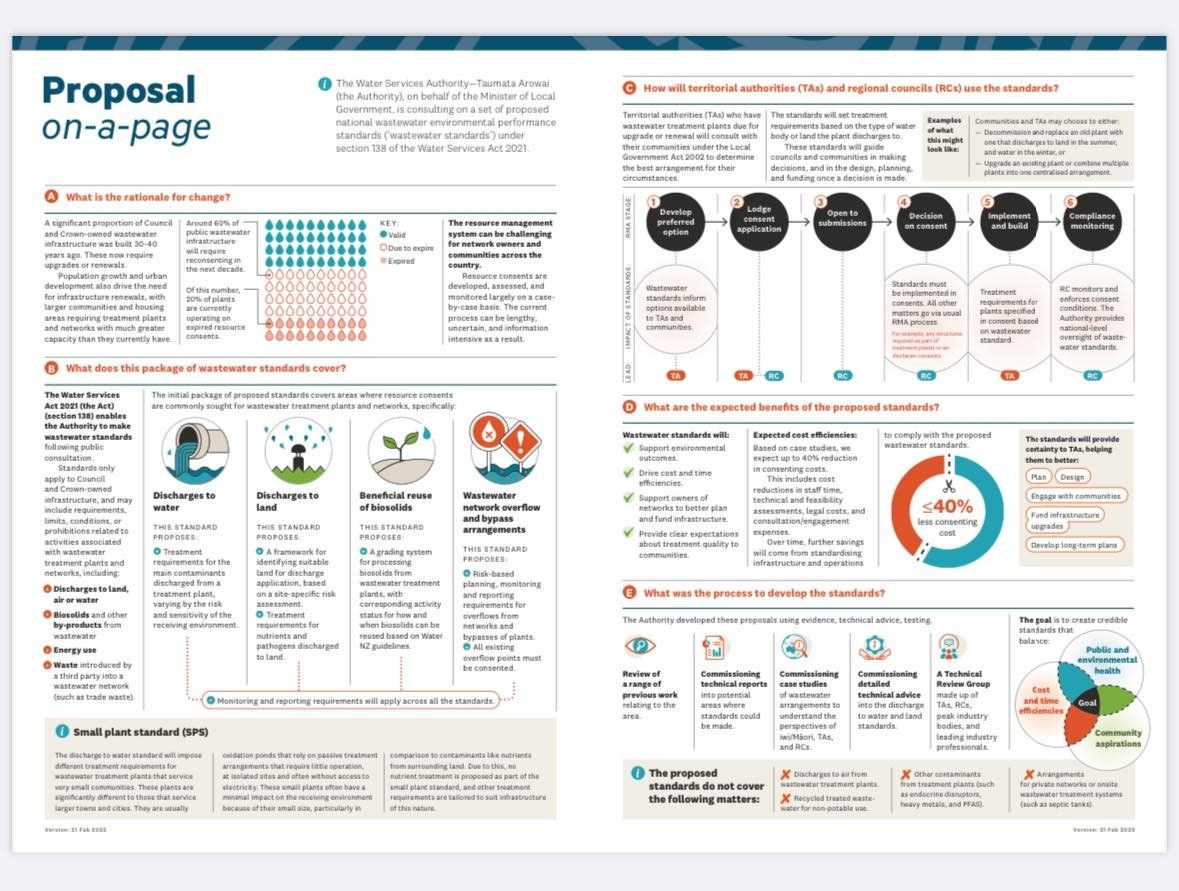
Taumata Arowai’s discussion document states that in the next decade, 57% of the country’s wastewater network plant infrastructure will require reconsenting; 20% of plants currently operate on expired resource consents. The regulator acknowledges that meeting the new standards will have significant impact on councils and their communities, on affordability and competing demands for how rates are spent, along with increased health and environmental risks.
Although there was still uncertainty around the costs and future delivery of water services, Ms Muir said Taumata Arowai’s proposals gave more certainty to tackling the big projects because they offered more consistency in national environmental standards and treatment quality, longer consent periods (35 years), reduced planning and consenting costs (by about 40%), greater standardisation of plant design and operation and increased risk management for overflows and plant bypass.
Based on the information currently available, Ms Muir said the first package of standards would cover discharges to water and land, reuse of biosolids, and overflows from networks and bypasses from pipe networks and treatment plants.
Council has proposed a new wastewater plant for Omakau to address flooding of the existing site and upgrading of the Alexandra wastewater plant to meet growth capacity requirements. The Omakau project cost has been estimated at $26.3 million based on a land discharge instead of a river discharge, as required under the current consenting system. The proposed environment performance standards would enable a standardised factory-built treatment plant in shipping containers to be used, with a continued discharge to river at a significantly reduced cost.
Ms Muir said Council had anticipated that the proposed changes would enable the existing Alexandra site to continue to be used at a cost of $35.5 million instead of a land discharge option which was previously priced in excess of $105 million. While there would be a cost saving on the Omakau project, further upgrades will be required at Ranfurly and Cromwell. As a result, there was no anticipated change to the long-term funding needs for wastewater treatment upgrades in Central Otago, she said.
Monitoring would be more stringent with fortnightly and monthly monitoring required instead of monthly and quarterly. There would also be significant increased reporting requirements and improved public access to test results. This information would require a third-party annual audit. From 1 July 2025, this work would be undertaken by council staff instead of being contracted out. The savings from resourcing this work internally would be used to fund the additional monitoring required.
The Local Government (Water Services) Bill which is currently being considered by Parliament takes changes to the Resource Management Act (RMA) to implement the proposed environment performance standards. The new standards will be implemented from August 2025.
In the discussion that followed, councillors were concerned that many people would not be able to afford to live in the communities that were most affected by the high cost of meeting the current standards. The changes proposed mean the community itself would be making the call on whether they would be willing to fund a higher cost discharge to land or a lower cost discharge to water; the options for Omakau being an example of having a high cost and low-cost option with cost/environmental implications for either option, which communities would be able to have input into, under the proposal.
A new approach to managing overflows and bypasses was proposed. In many regions, overflows were either treated as a prohibited activity (so consent cannot be sought), or as ‘emergency works’, under section 330 of the RMA. The discussion document suggested that this was just hiding the problem and was not a long-term solution; implementing a risk-based planning, monitoring and reporting framework for overflows was a more pragmatic approach to mitigating the effects of these unplanned events. Overflows at pumpstations would need to be consented. Historically, these were constructed to manage emergency overflows at pumpstations with a pipe to either the stormwater system or a waterway.
Council is required to provide feedback using a template from Taumata Arowai before the next Council meeting. Due to the tight timeframes, councillors will review the submission in mid-April and retrospectively approve at the Council meeting on 30 April.
The illustration below for the Water Services Authority – Taumata Arowai explains the rationale behind the proposed national environmental performance standards.